


Why Fall Is the Best Time to Install Sod and Turf in Alberta
Ask most homeowners in Airdrie when they should put in a new lawn, and they will tell you spring. It feels right — the snow is gone, the yard looks rough, and everyone wants it fixed by May long weekend. But if you ask the grass, you get a different answer.
Fall is quietly the best sod season we get in Alberta. The soil is still warm, the air has cooled off, the weeds have given up for the year, and your water bill drops. If you have been putting off a new lawn or an artificial turf install, the next few weeks are the window worth booking.
The short answer: late August through early October
In the Airdrie, Crossfield and Carstairs area, the sweet spot for laying sod runs from late August through the end of September, with early October as the outer edge depending on how the weather turns. Sod needs roughly two weeks to put down shallow roots and up to six weeks to build a strong root system, so the goal is to get it installed with enough runway before the ground freezes hard.
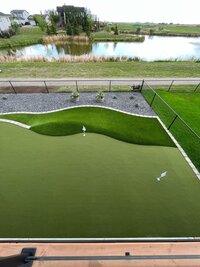
Artificial turf has a longer runway. It can go in any time the ground is not frozen and the base can be built dry, which in most years means we are still installing well into October and sometimes past it.
Why fall sod roots better than spring sod
Cool soil is exactly what roots want
Alberta lawns are cool-season grasses — mostly Kentucky bluegrass blends. Cool-season turf produces its best root growth when soil temperatures sit between roughly 10°C and 18°C, and root growth is at its strongest in spring and fall while dropping off sharply in the heat of summer.
That is the whole argument in one sentence. In September, the air has cooled but the soil is still holding summer heat, which puts you right in that ideal band. Sod laid in July is fighting to survive; sod laid in September is busy building roots.
The grass sends its energy downward
As days shorten and top growth slows, cool-season grass stops pushing blades and starts investing in roots and crowns. A fall lawn looks like it is doing nothing while it is actually doing the most important work. That is why a fall install often comes out of winter stronger than a lawn planted the previous spring — it has had a full season underground with no summer heat stress to survive.
Fewer weeds competing for the space
Annual weeds have finished their cycle by late summer. New sod put down in spring has to compete with everything germinating at the same time, while fall sod gets to establish into much cleaner ground. Less competition early means a denser, more even lawn later.
Fall installs need a lot less water
New sod still needs consistent moisture in the first couple of weeks — that does not change with the season. What changes is how much. Cooler air, shorter days, weaker sun and more reliable fall rain mean far less evaporation, so you are watering less often and for less time than you would in July.
For a lot of our clients that is the deciding factor. A summer sod install means committing to watering twice a day through the hottest stretch of the year, often under outdoor water restrictions. A September install is a much easier promise to keep.
How late can you actually lay sod in Airdrie?
Our average first frost lands around mid-September, but do not let that date scare you off. A first frost is not the end of the growing season here — chinooks routinely bring us mild, well-above-freezing weather through late September and October, and soil holds its temperature long after the air turns cold. Roots keep working after the blades stop growing.
The number that actually matters is when the ground freezes solid, not the first light frost on your windshield. As a practical rule for our area:
- Late August to late September — the ideal window. Plenty of time to root before freeze-up.
- Early to mid October — still workable in most years, and worth doing. The lawn roots partially, goes dormant, and finishes establishing in spring.
- Once the ground is frozen — time to stop. Sod cannot knit into frozen soil, and the ground needs to be properly prepared and graded first.
If you are on the fence, the honest advice is that laying sod in early October is still far better than leaving bare dirt or dead lawn to sit over winter. Bare soil erodes, ruts and turns into a spring mud problem.
Artificial turf: fall is a scheduling advantage, not a biological one
With artificial turf, none of the rooting math applies — there is nothing to establish. The case for a fall install is a practical one:
- No establishment period at all. The yard is finished and usable the day we leave, with no watering schedule and no waiting to walk on it.
- The excavation is easier now. Turf lives or dies on its base, and building a proper compacted base means digging. That is straightforward work in September and miserable work once frost is in the ground.
- It is ready the moment spring hits. You skip the spring mud season entirely and have a green, usable yard in March instead of waiting in line for a summer install.
The one real constraint is cold. Turf backing and seaming adhesives cure more slowly in low temperatures, and the base has to be built on ground that is not frozen and free of snow and ice, with the turf dry before infill goes down. None of that is a problem in September and early October — it just means late-season turf work needs to be scheduled rather than squeezed in.
Still deciding between the two? We compared them in detail in artificial turf vs. real grass.
What else is worth getting done before freeze-up
Fall is the right time for most of the heavy work in a yard, not just the lawn. While the ground is still workable, it is worth handling:
- Grading and drainage — fixing where water pools before snowmelt finds it for you in March.
- Excavation and dirt work — far easier in unfrozen ground.
- Fence installation — post holes are much simpler to dig now.
- Landscape design — the smartest fall move of all. Design over winter, and you are first in the ground come spring instead of joining the April queue.
Frequently asked questions
No. September is one of the best months of the year for it. Soil temperatures are in the ideal range for root growth, weed pressure is low and watering demands are much lower than in summer.
Yes, provided it goes down with enough time to root and gets watered properly until freeze-up. Sod laid in the fall goes dormant over winter and greens up in spring — often more vigorously than spring-laid sod, because it enters the season with an established root system.
Yes, but noticeably less. Keep the sod and the top inch of soil consistently moist for the first two weeks, then water deeply and less often. Keep watering until the ground freezes, then stop.
It can, as long as the ground is not frozen and the base can be built on dry, snow-free ground. Adhesives take longer to cure in the cold, so late-season installs need a little extra time built into the schedule.
Generally, yes. Spring is the busiest stretch of the year for every contractor in the region, and calendars fill fast. Booking work in the fall usually means more flexibility on timing and a finished yard heading into winter rather than a wait list heading into summer.
Let’s get your yard done before the ground freezes
With 32+ years of combined experience across Airdrie, Crossfield, Carstairs, Rocky View County and Mountain View County, we have installed a lot of lawns in a lot of Septembers — and we would rather see you get a full season of root growth than wait until spring for a lawn that spends its first summer struggling.
Whether it is sod and landscape installation, artificial turf, or a design to break ground on in spring, the fall calendar is filling up now. Give us a call at (587) 998-3058 or request a quote, and let’s build the yard you actually want.
CATEGORY:
9/08/2026


Comments Off on Why Fall Is the Best Time to Install Sod and Turf in Alberta